

Planning an event is no easy feat. Whether you are organising a small community gathering or a large-scale festival, the right temporary fencing solution is one critical factor that can make a big difference in how smoothly everything runs. The right setup keeps people safe, eliminates trip hazards, prevents unauthorised access, and complies with Australian safety standards, while giving your team better site control.
However, when planning fencing solutions, many event organisers overlook temporary fencing size, height, layout, and access points. Each detail helps create a safe, organised space where people can move around safely and comfortably.
That’s why it’s important to know about the standard sizes available and how they fit different event needs. Only then can you choose the right event fencing to protect attendees and equipment, control the crowd, and manage your event operations.
What Is a Standard Temporary Fencing Size?
The standard temporary fencing size in Australia is 2400mm (2.4m) wide by 2100mm (2.1m) high. This conforms with key standards, including AS4687.2:2022 for Temporary Fencing and Hoardings. All solutions should also meet wind-loading requirements under AS1170.2 Structural Design Actions: Wind Actions. Solutions certified for wind resistance up to 165 km/h ensure full compliance and remain secure throughout the event.
Common Panel Dimensions
Temporary fencing panels in Australia commonly come in three height categories: 1.8m for residential applications, 2.1m for standard construction sites, and 2.4m for high-risk areas. The panels typically use 32mm to 42mm outer-diameter pipes with wall thicknesses of about 1.5mm to 2.0mm.
The welded wire mesh generally has openings of about 150mm x 60mm, with galvanised steel wire around 3-4mm thick. Panels may be available at around 1.8m high for lower-risk residential applications, while higher-security sites may use panels up to 2.4m high.
Fencing Feet and Clamps
The panels sit in heavy-duty plastic or concrete-filled feet for stability and to keep the fence upright. A standard base is roughly around 600mm x 200mm x 150mm and may weigh around 24-32 kg when filled, based on construction.
Coupling clamps protect neighbouring panels together at their upright frames. Generally made from pressed or cast steel, they fasten with nuts and bolts to create a continuous, more stable fence line. However, these dimensions can vary between suppliers and fencing systems. Always confirm the specifications before calculating your site requirements.
How to Choose Temporary Fencing Size by Site Type
The right temporary fencing size largely depends on your purpose. Construction sites need tall, secure panels to stop intruders from entering the premises, while event organisers need crowd-control barriers or medium-height fences. Residential areas and pools need safe, climb-resistant boundaries. Matching the fence to the site’s purpose makes the setup purposeful, safer, and easier to manage.
Construction Sites
Construction sites usually use 2.1m-high and 2.4m-wide panels to create clear boundaries and keep trespassers out. Choose a heavy rubber or concrete base to keep the fence stable in high winds.
Events and Crowds
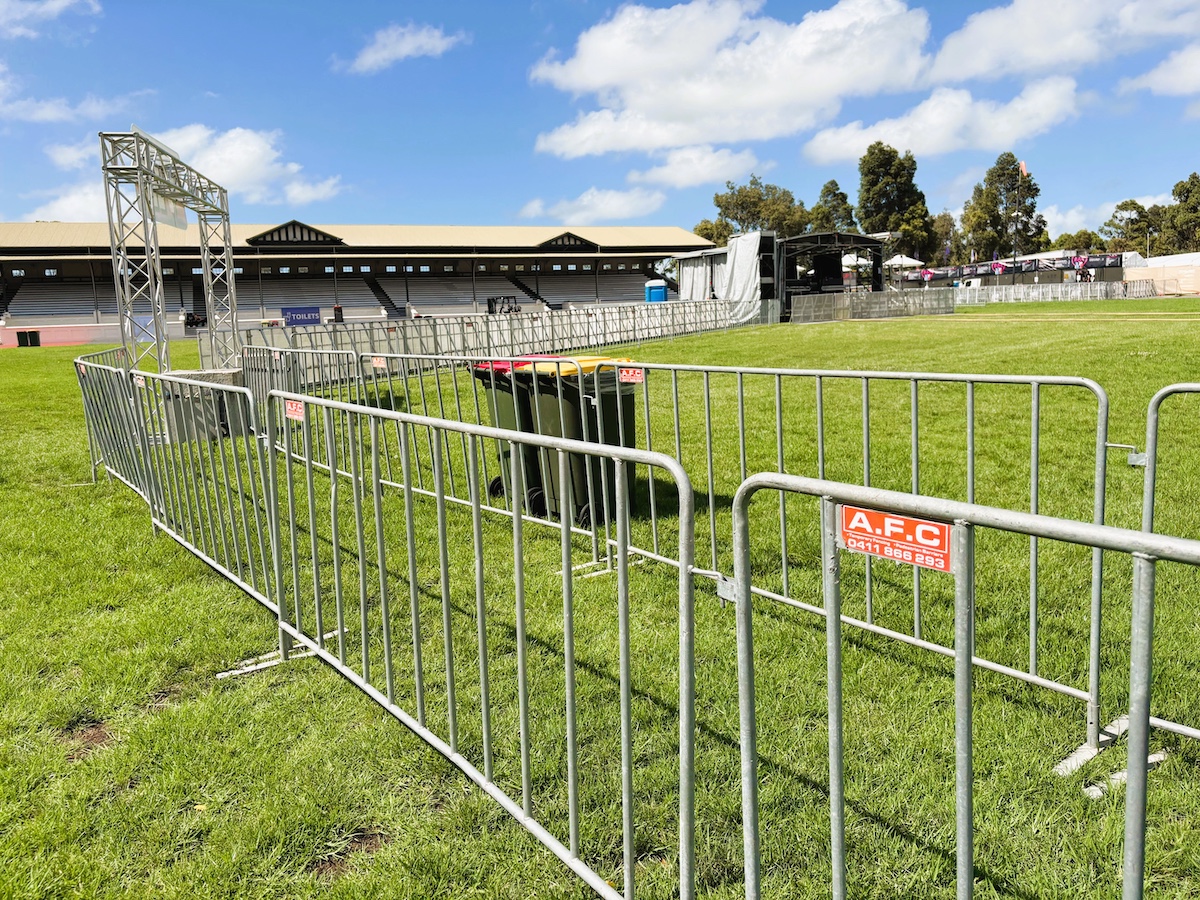
For festivals, markets, community gatherings, and sporting events, fencing should control crowd movement rather than simply block access. Short barriers are more suitable for guiding walking crowds safely, while tall fences block restricted backstage or ticket zones. Use 1.1 to 1.8m-high barriers for pedestrians and 2.1m for larger crowds. Consider barrier frames 2.1 to 2.5m long and flat feet on pedestrian barriers to avoid tripping hazards.
Pools and Residential Areas
Residential areas often involve limited spaces around footpaths, gardens, driveways, and neighbouring properties. A 1.2 to 1.8m high fence may suit low-risk areas based on local council rules. Standard 2.4m panels are better suited for home perimeters.
For pools, the legal barrier height is 1.2m, with a physical frame height of 1.3m to 1.38m and a panel typically around 2.2m to 2.5m in width. The gap between the fence panel and the ground, as well as the vertical wires or bars, should not exceed 100 mm at any point.
How to Calculate the Number of Temporary Fencing Panels Needed
Accurate panel calculations can prevent unnecessary costs and last-minute shortages. To calculate the number of temporary fencing panels necessary, divide the total perimeter length by the standard panel length (2.4m) and add extra for gates and overlaps.
Measure the Perimeter
Add the length of every boundary that requires fencing. Divide the total by the standard panel width and round up to the next whole panel. For example, a 48m perimeter using 2.4m panels requires 20 panels.
Allow for Gates
First, determine the required width for truck and workers’ access. Subtract the total gate width from the overall perimeter. While standard vehicle gates use regular joined panels, pedestrian gates require a specialised 1.1m-wide panel. Also add extra clamps and wheels to the total order, plus one extra panel to cover gaps.
Factors That Affect Temporary Fencing Height and Layout
Ground conditions, wind exposure, and screening strictly dictate temporary fencing height and layout. Ground conditions determine base anchoring and the required weight, while wind forces and privacy screens can increase the risk of panel tipping or collapse.
Ground Conditions
- Concrete, asphalt, grass, and uneven surfaces can affect how fencing feet sit
- Sloping ground or uneven terrain requires careful positioning and tighter connection intervals to prevent gaps, leaning, or unstable panels.
- Heavy rain or soft, loose, or saturated soil can weaken base stabilisation and increase the risk of support feet sinking.
Wind and Screens
- Strong winds create a sail effect. Taller fences catch more wind, multiplying lateral pressure and making structures sway or topple.
- Solid shade cloth or privacy banners trap wind and increase wind load, while open-weave mesh allows airflow and reduces the total load.
- Exposed sites or screened fencing require additional bracing, anchoring, or heavier base weights to maintain stability.
Frequently Asked Questions (FAQs)
How tall should temporary fencing be?
In Australia, the temporary fencing height depends on the specific use. Construction and work sites typically require a minimum height of 1.8m to 2.1m, while swimming pools require a minimum of 1.2m with a maximum 10cm gap at the bottom. For events and crowd control, a 1.8m-high barrier is commonly used.
What is the most common temporary fencing size?
The most common temporary fencing size in Australia is 2.1m high by 2.4m wide (2100mm H × 2400mm W).
How do I calculate how many temporary fencing panels I need?
To calculate the number of temporary fencing panels:
- Measure the perimeter by calculating the total length of the area you need to fence in metres.
- Subtract the width of any gates or openings from the total length.
- Identify panel length (which is usually 12 feet (3.6m) or 10 feet (3m) long) and divide the adjusted total length by the panel length.
- Round up the decimal to the nearest whole number.
Do temporary fencing panels need bracing?
Yes, temporary fencing panels may need bracing if the site is exposed to strong winds, uneven terrain, heavy screening, and long straight runs.
Can temporary fencing sizes be customised?
Absolutely! Temporary fencing sizes can be customised in different panel widths, heights, gates, feet, frame thickness, and mesh spacings to match specific security requirements, perimeter layouts, or local guidelines.